922. Taruṇāditya-pāṭalā
Taruṇāditya-pāṭalā reveals the Divine Mother as shining with the rosy-red brilliance of the newly risen sun. Revered in Śrīvidyā as a symbol of divine beauty, creative power, and spiritual awakening, her crimson radiance dispels the darkness of ignorance and fills the heart with illumination. The name teaches that the Divine Mother is the ever-fresh dawn of Consciousness, whose light reveals the truth of the Self and the splendor of existence.

Taruṇāditya-pāṭalā (तरुणादित्यपाटला)
This is the 922nd name of the Lalitā Sahasranāma.
After revealing the Divine Mother as Sadātuṣṭā, eternally fulfilled and content, the Sahasranāma now returns to a vivid and beautiful visual meditation on her divine form:
Taruṇāditya-pāṭalā: She who is rosy-red like the rising young sun; She whose complexion resembles the crimson radiance of the newly risen sun; She who shines with the fresh brilliance of dawn.
This name combines beauty, symbolism, cosmology, and spiritual illumination.
1. Literal Meaning
Word-by-word
Taruṇa (तरुण)
young,
fresh,
newly arisen,
youthful.
Āditya (आदित्य)
the sun.
Pāṭalā (पाटला)
rosy-red,
crimson,
pinkish-red,
glowing scarlet.
Literal translation
"She who is crimson like the rising young sun."
or
"She whose complexion resembles the rosy radiance of dawn."
or
"The Goddess shining with the hue of the newly risen sun."
2. Traditional Meaning
The commentators explain:
The Goddess is called Taruṇāditya-pāṭalā because her complexion resembles the soft crimson glow of the rising sun.
This imagery is beloved throughout Śrīvidyā literature.
3. Why the Rising Sun?
The name does not compare her to the midday sun.
Nor to the setting sun.
It specifically invokes the young rising sun.
This moment symbolizes:
freshness,
awakening,
hope,
beauty,
spiritual illumination.
The dawn sun is powerful yet gentle.
This perfectly suits the Divine Mother.
4. Why Does This Name Follow Sadātuṣṭā?
The sequence is subtle.
Sadātuṣṭā
The Mother is inwardly complete and eternally fulfilled.
Taruṇāditya-pāṭalā
That inner fullness radiates outward as divine brilliance.
Contentment becomes radiance.
Fulfillment becomes light.
5. Śrīvidyā Meaning
In Śrīvidyā, the Goddess is frequently visualized as:
red,
crimson,
coral-hued,
dawn-colored.
This color symbolizes:
Śakti,
creative power,
bliss,
consciousness becoming manifest.
Thus Taruṇāditya-pāṭalā is a classic Śrīvidyā visualization.
6. The Color of Śakti
Red in Śākta symbolism signifies:
life,
energy,
vitality,
love,
manifestation.
The Mother's crimson radiance represents the dynamic power through which the universe appears.
7. Devotional Meaning
For devotees, this name evokes a beautiful meditation.
One may visualize the Mother:
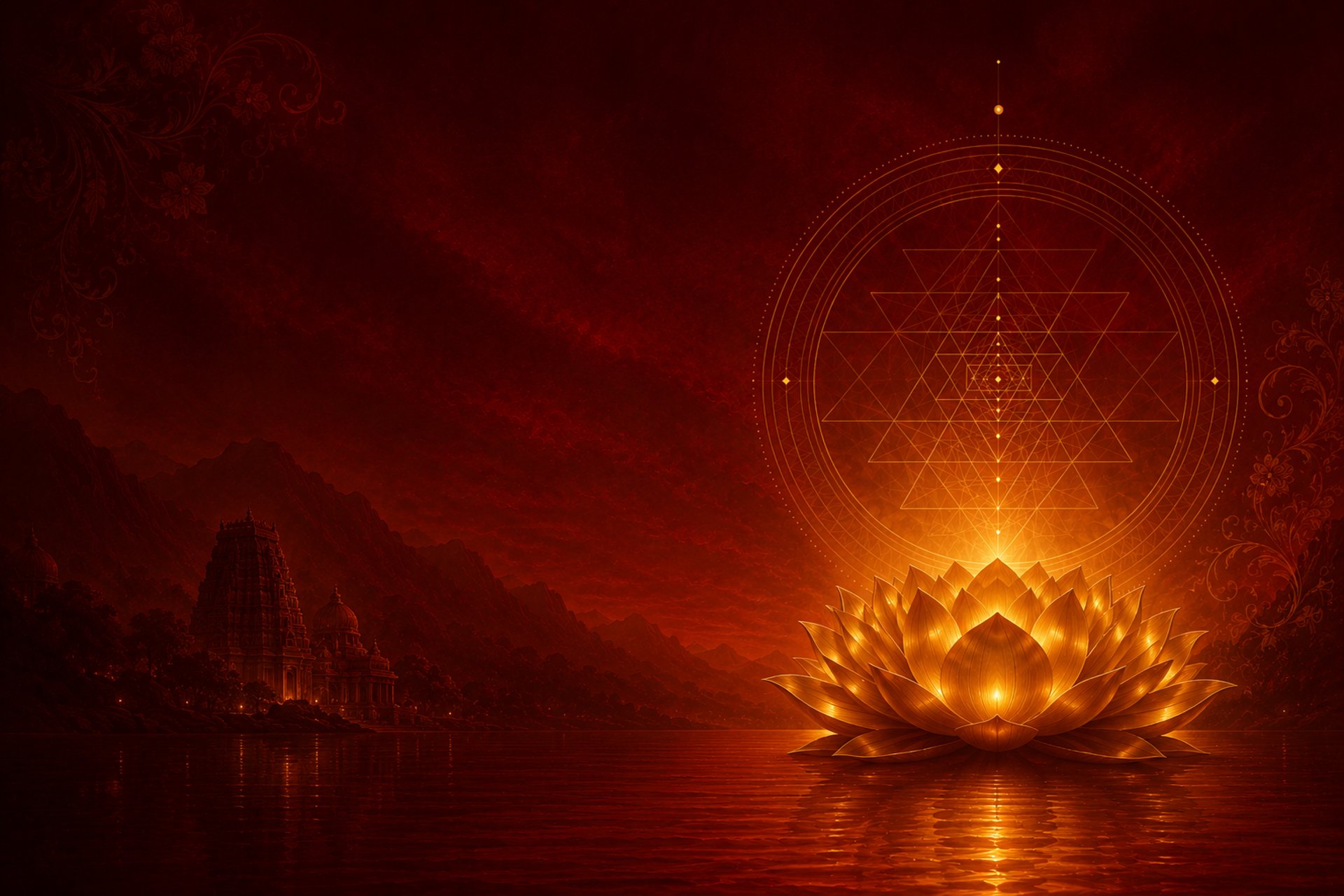
seated on the Śrīcakra,
shining with a soft crimson glow,
radiant like the first light of dawn,
illuminating the hearts of her devotees.
This image inspires devotion and contemplation.
8. Dawn as Spiritual Awakening
The rising sun has long symbolized enlightenment.
Night represents:
ignorance,
confusion,
forgetfulness.
Dawn represents:
wisdom,
awakening,
revelation.
The Mother as Taruṇāditya-pāṭalā is the dawn of spiritual knowledge.
9. Advaita Vedāntic Meaning
Now the deepest layer.
A profound question
Why is Consciousness compared to a rising sun?
The hidden teaching
Because realization dispels ignorance just as sunlight dispels darkness.
The Sun of Awareness
Darkness cannot resist light.
It disappears automatically.
Similarly:
Ignorance vanishes when knowledge arises.
The Mother is that illuminating awareness.
Ever-New Consciousness
The word taruṇa (young, fresh) is important.
Consciousness never grows old.
Every moment of awareness is immediate and fresh.
The Mother is eternally youthful because pure Consciousness is never subject to decay.
The Crimson Dawn of Realization
Before realization, life appears fragmented.
When truth begins to dawn, the seeker's vision changes.
The first glimpse of the Self is like sunrise.
The Mother is that dawn.
The Union of Beauty and Knowledge
Unlike a harsh blaze, the dawn sun combines:
beauty,
warmth,
illumination.
Similarly, the Mother's wisdom is not cold abstraction.
It is radiant, compassionate, and life-giving.
Relation to Earlier Names
Observe the progression:
Sadoditā – Ever-risen Consciousness.
Sadātuṣṭā – Ever-content Consciousness.
Taruṇāditya-pāṭalā – Consciousness shining as the crimson dawn of awakening.
The Sahasranāma now gives visual form to the luminous reality it has been describing philosophically.
The Non-Dual Meaning
At the highest level, Taruṇāditya-pāṭalā signifies the radiant manifestation of Supreme Consciousness as the light of spiritual awakening. Like the rising sun that dispels darkness, the Divine Mother illumines the mind and reveals the ever-present truth of the Self.
A Deeper Contemplation
The name Taruṇāditya-pāṭalā is among the most beautiful visual descriptions in the Sahasranāma.
The Mother is not merely radiant.
She shines with the tender crimson glow of dawn.
The sequence after Sadātuṣṭā is especially meaningful.
The Mother is first revealed as inwardly fulfilled.
Then that fullness appears outwardly as luminous beauty.
From a devotional perspective, Taruṇāditya-pāṭalā is the Goddess whose form radiates the enchanting hue of the rising sun.
From a symbolic perspective, she is the dawn that dispels the darkness of ignorance.
From a Śākta perspective, her crimson color represents the dynamic power of Śakti and the bliss of manifestation.
From an Advaitic perspective, she is the light of awareness through which all knowledge becomes possible.
She is the dawn of wisdom.
She is the radiance of Consciousness.
She is the light that awakens the soul.
Ultimately, Taruṇāditya-pāṭalā teaches that the Divine Mother shines with the fresh crimson radiance of the rising sun, symbolizing beauty, vitality, spiritual awakening, and the illuminating power of Consciousness. Through this name, the seeker learns that realization is like dawn: the darkness of ignorance gradually recedes, and the ever-present light of the Divine Mother becomes visible in all its splendor.
To contemplate Taruṇāditya-pāṭalā is to behold the Divine Mother as the rosy dawn of enlightenment rising within the heart.
One-line Essence
Taruṇāditya-pāṭalā reveals the Divine Mother as the crimson radiance of the rising sun that awakens and illumines all existence.