875. Tripuramālinī
Tripuramālinī reveals the Divine Mother as the sovereign Goddess who unites and governs the three worlds, the three states of consciousness, and all sacred triads. Like the unseen thread holding together a garland, she binds the diversity of existence into a single harmonious whole. The name teaches that beneath all multiplicity lies the one Consciousness of the Divine Mother, who pervades, sustains, and transcends every aspect of creation.

Tripuramālinī (त्रिपुरमालिनी)
This is the 875th name of the Lalitā Sahasranāma.
After revealing the Divine Mother as Tristhā, abiding in all sacred triads, the Sahasranāma now presents one of the most important and esoteric names in the entire Śrīvidyā tradition:
Tripuramālinī: She who is adorned with the three cities; She who is the presiding Goddess of the Tripurā mystery; She who strings together and governs the three worlds, the three states, and all triads into a unified whole.
This name is deeply connected with Śrīcakra, Śrīvidyā mantra-śāstra, and the doctrine of Tripurā.
1. Literal Meaning
Word-by-word
Tri
three.
Pura
city,
fortress,
realm,
field of experience.
Mālinī
garlanded one,
she who wears as a garland,
she who strings together.
Literal translation
"She who wears the three cities as a garland."
or
"She who is the Garland of the Three Cities."
or
"The Goddess who unites and governs the three realms."
2. Traditional Meaning
The commentators explain:
The Goddess is called Tripuramālinī because she presides over the three puras (tripuras) and unites them within herself.
She is one of the important forms of the Divine Mother in Śrīvidyā worship.
3. What Are the "Three Cities"?
The word Tripura has many layers of meaning.
It can refer to:
The Three Worlds
Earth,
Mid-region,
Heaven.
The Three States
Waking,
Dream,
Deep Sleep.
The Three Bodies
Gross,
Subtle,
Causal.
The Three Guṇas
Sattva,
Rajas,
Tamas.
The Mother pervades and unites them all.
4. Why "Mālinī"?
A garland is created when many flowers are threaded on a single string.
Similarly:
worlds,
states,
bodies,
guṇas,
appear diverse.
The Mother is the hidden thread uniting them.
Thus she is Mālinī.
5. Why Does This Name Follow Tristhā?
The sequence is extremely elegant.
Tristhā
She abides in all triads.
Tripuramālinī
She not only abides in them.
She gathers them together into a single harmonious unity.
The Sahasranāma moves from presence within the three to sovereignty over the three.
6. Śrīvidyā Meaning
In Śrīvidyā, Tripurā is one of the most sacred names of the Goddess.
She is called Tripurā because she transcends and illumines:
the three worlds,
the three states,
the three divisions of experience.
Tripuramālinī is a specialized form emphasizing her mastery over these triads.
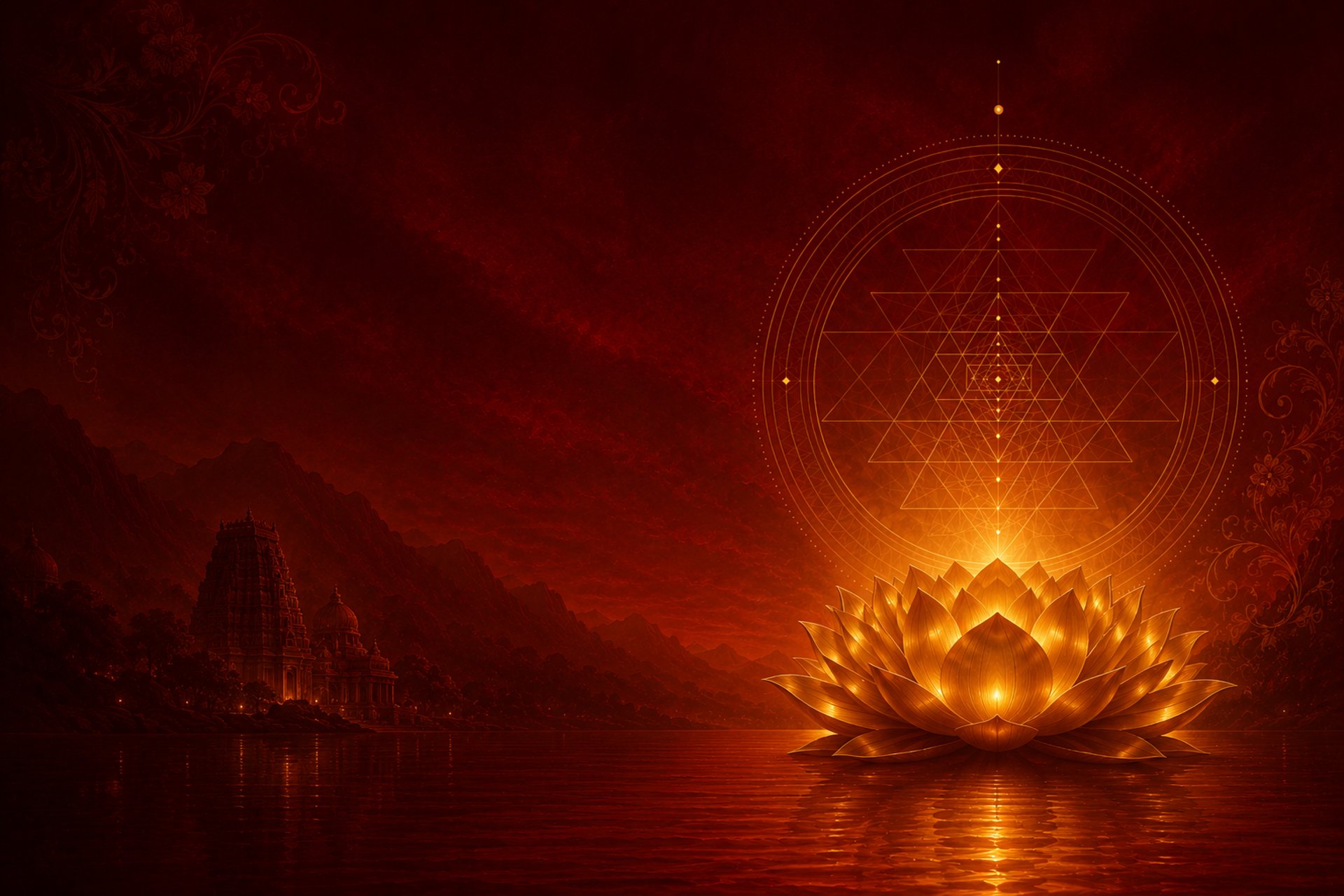
She is also associated with one of the inner mysteries of the Śrīcakra and the Śrīvidyā mantra tradition.
7. Devotional Meaning
For devotees, this name expresses the Mother's universal sovereignty.
Nothing exists outside her domain.
Every realm of existence is woven together by her presence.
8. The Garland Symbolism
The flowers of a garland may appear separate.
The thread remains hidden.
Likewise:
beings appear separate,
experiences appear separate,
worlds appear separate.
The Mother is the unseen unity connecting all.
9. Advaita Vedāntic Meaning
Now the deepest layer.
A profound question
What is the common factor in all states and experiences?
The hidden teaching
Consciousness.
The Three Cities as Experience
The "three cities" can be understood as:
waking experience,
dream experience,
deep sleep.
These seem different.
Yet all are illumined by the same awareness.
The Hidden Thread
Just as a garland depends upon a thread,
all experiences depend upon Consciousness.
That Consciousness is the Mother.
Thus she is Tripuramālinī.
Beyond the Three
A garland-maker is not part of the garland.
Similarly, the Mother is not limited to the three states.
She transcends them.
This echoes:
Tristhā — abiding in the three.
Tripuramālinī — uniting the three.
And implicitly, transcending the three.
The Māṇḍūkya Connection
The Māṇḍūkya Upaniṣad speaks of:
waking,
dream,
deep sleep,
and then reveals Turīya, the Fourth.
Tripuramālinī may be contemplated as that consciousness which threads together the three states while itself remaining beyond them.
The Śrīvidyā Secret
The Divine Mother is called Tripurā because she shines through all three states of experience.
She is called Tripuramālinī because she binds them into a single reality.
Relation to Earlier Names
Observe the progression:
Trayī – The three Vedas.
Trivarga-nilayā – The three goals of life.
Tristhā – Abiding in the triads.
Tripuramālinī – Uniting and governing the triads.
The Sahasranāma now reveals the Mother as the hidden unity behind all threefold structures.
The Non-Dual Meaning
At the highest level, Tripuramālinī signifies the Supreme Consciousness that threads together all states, worlds, and experiences into a single unified reality. She is the hidden principle of unity behind all apparent multiplicity.
A Deeper Contemplation
The name Tripuramālinī is one of the jewels of the Śrīvidyā tradition.
It reveals the Mother not merely as present within creation but as the secret unity holding creation together.
The sequence after Tristhā is especially profound.
The Mother is first revealed as abiding in all triads.
Then she is revealed as the one who strings them together into a harmonious whole.
From a devotional perspective, Tripuramālinī is the sovereign Goddess ruling all worlds.
From a symbolic perspective, she is the hidden thread uniting the flowers of existence.
From a Śākta perspective, she is the great Tripurā of Śrīvidyā.
From an Advaitic perspective, she is the one Consciousness illumining waking, dream, and deep sleep.
The worlds are many.
The states are many.
The experiences are many.
The Mother is one.
Ultimately, Tripuramālinī teaches that the Divine Mother is the unifying principle behind all triads and all realms of existence. Like a hidden thread holding together a garland, she connects the many into a single harmonious whole. Through this name, the seeker learns that beneath the diversity of worlds, states, and experiences lies the one Consciousness of the Divine Mother, who both pervades and transcends all creation.
To contemplate Tripuramālinī is to perceive the Divine Mother as the secret thread of unity running through the entire fabric of existence.
One-line Essence
Tripuramālinī reveals the Divine Mother as the hidden thread of consciousness that unites all triads into one reality.