495. Maṇipūrābja-nilayā
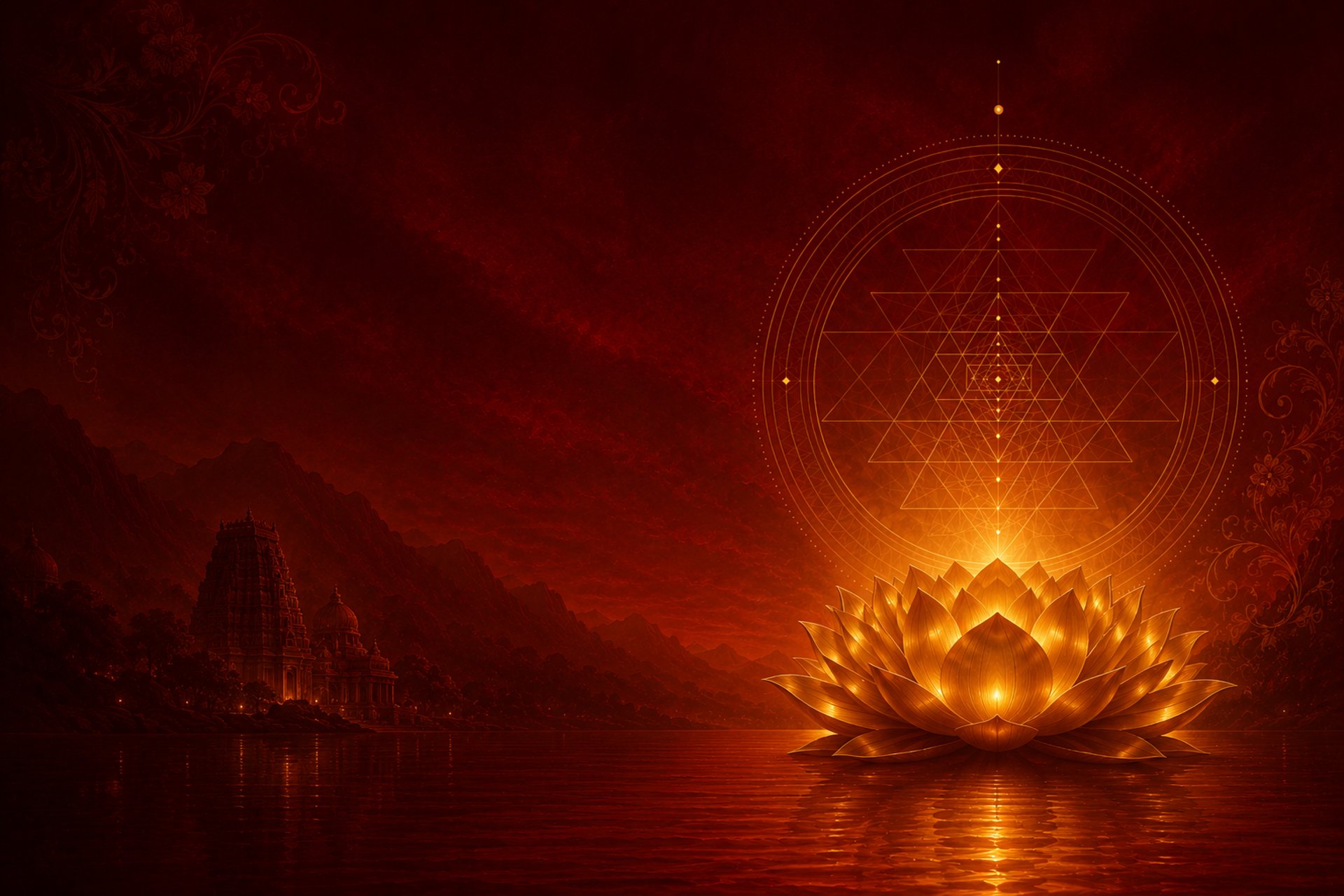
Maṇipūrābja-nilayā reveals the Divine Mother as residing in the lotus of the Maṇipūra Chakra, the radiant center of fire, transformation, and inner power. The name teaches that spiritual growth requires not only understanding but transformation, and that the Divine presence within awakens courage, determination, and the luminous strength needed to uncover the hidden jewels of the soul.

Maṇipūrābja-nilayā (मणिपूराब्जनिलया)
This is the 495th name of the Lalitā Sahasranāma.
With this name, the Sahasranāma moves from the Anāhata (Heart) Chakra to the Maṇipūra Chakra.
The previous section concluded with:
Rākiṇyambā-svarūpiṇī — The Divine Mother as Rākiṇī, the Yoginī of the Heart Lotus.
Now a new chakra meditation begins:
Maṇipūrābja-nilayā — She who resides in the lotus of the Maṇipūra Chakra.
As before, the Sahasranāma will first reveal her abode and then describe her form, powers, attendants, offerings, and presiding Yoginī manifestation.
1. Literal Meaning
Word-by-word
Maṇipūra – "city of jewels" or "jewel-filled center"
Abja – lotus
Nilayā – dwelling, abode, residence
Literal translation
"She who resides in the lotus of the Maṇipūra Chakra."
or
"She whose abode is the Maṇipūra Lotus."
2. What Is the Maṇipūra Chakra?
The Maṇipūra Chakra is traditionally located in the navel region.
It is visualized as:
a lotus with ten petals,
radiant like a blazing sun,
associated with the element of fire (agni),
connected with transformation, vitality, will, and inner power.
3. Why Is It Called Maṇipūra?
The word literally means:
"City of Jewels."
This imagery suggests:
hidden treasures,
inner wealth,
spiritual power,
luminous potential.
Just as a city contains many riches, this chakra contains immense transformative energy.
4. Traditional Meaning
The Divine Mother is called Maṇipūrābja-nilayā because she dwells in the lotus of the Maṇipūra Chakra.
In yogic contemplation, this center governs:
digestion,
vitality,
determination,
transformation,
dynamic energy.
The Mother presides over all these functions.
5. Why Does This Name Follow Rākiṇyambā-svarūpiṇī?
The sequence follows the established chakra progression.
Anāhata
The realm of love and devotion.
Maṇipūra
The realm of power and transformation.
The journey now moves from the heart's expansive love to the fire that transforms and energizes life.
6. Devotional Meaning
For a devotee, this name teaches that the Mother is the source of inner strength.
Whenever one finds:
courage,
determination,
resilience,
the power to persevere,
her presence is at work.
She dwells as the fire of spiritual effort.
7. Śrīvidyā Meaning
In Śrīvidyā, the Maṇipūra Chakra represents the transformative aspect of Śakti.
Fire occupies a special place in spiritual symbolism because it:
consumes impurities,
transforms what it touches,
produces light,
generates energy.
The Mother residing here is the force of inner transformation.
8. The Symbolism of Fire
The element associated with Maṇipūra is Agni (Fire).
Fire performs several symbolic functions:
Transformation
Food becomes energy.
Experience becomes wisdom.
Purification
Impurities are burned away.
Illumination
Fire gives light.
Power
Fire generates movement and change.
All these qualities belong to the Mother in this chakra.
9. Advaita Vedāntic Meaning
Now the deeper layer.
A profound insight
Why is a spiritual center associated with fire?
Because realization requires transformation.
The hidden teaching
Knowledge alone is not enough.
The seeker's life must be transformed by that knowledge.
The Maṇipūra fire represents this process.
The Inner Furnace
Every spiritual path involves refining the personality.
Fear becomes courage.
Attachment becomes freedom.
Confusion becomes clarity.
The Mother dwelling in Maṇipūra is this refining power.
The Treasure Within
The name "City of Jewels" suggests that immense riches already exist within the seeker.
The journey is not about acquiring something new.
It is about uncovering hidden treasure.
Energy and Awareness
Ordinary energy fuels activity.
Spiritual energy fuels awakening.
The Mother here appears as the force that drives the search for truth.
The Fire of Aspiration
The desire for realization is itself a form of grace.
That longing, that aspiration, that refusal to settle for superficial answers—all are expressions of the Mother's presence in Maṇipūra.
Relation to Earlier Names
Observe the progression:
Rākiṇyambā-svarūpiṇī — The Mother as the power of the awakened heart.
Now:
Maṇipūrābja-nilayā
The Mother as the transformative fire that gives strength, vitality, and spiritual momentum.
Love becomes power.
Compassion becomes action.
The Non-Dual Meaning
At the highest level, the Maṇipūra fire symbolizes the power of Consciousness to reveal itself.
Just as fire transforms everything placed within it, awareness transforms every experience by illumining it.
The Mother is called Maṇipūrābja-nilayā because she abides as the luminous power of transformation within the seeker's own being.
A deeper contemplation
The spiritual journey is not merely a matter of understanding.
It is a matter of transformation.
Many people recognize truth intellectually yet struggle to embody it.
The sages therefore emphasized the importance of inner fire.
The Divine Mother as Maṇipūrābja-nilayā resides in the City of Jewels because the greatest treasures are hidden within.
Courage, resilience, clarity, determination, and spiritual strength are not imported from outside.
They emerge from the depths of one's own being.
The fire of Maṇipūra reveals these treasures.
This chakra also teaches an important lesson about power.
Ordinary power seeks control.
Spiritual power seeks transformation.
The Mother's presence here is not about domination but refinement.
She burns away what is unnecessary and reveals what is essential.
The symbolism of fire is therefore deeply appropriate.
Fire destroys, but it also purifies.
It consumes, but it also illuminates.
It transforms raw material into something more refined.
The Mother performs the same function in the seeker's life.
Ultimately, Maṇipūrābja-nilayā reveals that the Divine is not only the goal of the journey but also the energy that sustains it.
The fire of aspiration, the strength to persevere, and the transformation that unfolds along the way are all expressions of her presence.
To contemplate Maṇipūrābja-nilayā is to recognize the Divine Mother as the radiant fire of transformation dwelling within the City of Jewels, awakening strength, illuminating the path, and revealing the hidden treasures of the spirit.
One-line Essence
Maṇipūrābja-nilayā reveals the Divine Mother as the transformative fire dwelling in the City of Jewels, awakening strength, vitality, and the hidden spiritual treasures within the seeker.