380. Bindu-maṇḍala-vāsinī
Bindu-maṇḍala-vāsinī reveals the Divine Mother as the one who dwells in the sacred Bindu, the central point of the Śrīcakra and the source of all manifestation. The name teaches that beneath the apparent multiplicity of existence lies a single, non-dual reality—the infinite Consciousness that is both the origin and culmination of the spiritual journey.
Bindu-maṇḍala-vāsinī (बिन्दुमण्डलवासिनी)
This is the 380th name of the Lalitā Sahasranāma.
After revealing the Divine Mother as Oḍyāṇa-pīṭha-nilayā, dwelling in the sacred seat of spiritual ascent, the Sahasranāma now arrives at one of the most profound and central names in all of Śrīvidyā:
Bindu-maṇḍala-vāsinī — She who dwells in the Bindu; She who abides in the central point of the Śrīcakra; She who resides in the primordial source from which the entire universe emerges.
This name takes us directly to the heart of Śrīvidyā metaphysics, cosmology, and non-dual realization.
1. Literal Meaning
Word-by-word
Bindu – point, seed-point, source-point, primordial center
Maṇḍala – circle, sphere, sacred field, spiritual domain
Vāsinī – she who dwells, resides, abides
Literal translation
"She who dwells in the Bindu-maṇḍala."
or
"The One who abides in the primordial center."
2. What Is the Bindu?
In ordinary language, a bindu is simply a dot or point.
In Śrīvidyā, however, the Bindu is one of the most sacred symbols.
It represents:
the source of creation,
the unmanifest seed of the universe,
the point where all multiplicity exists in potential,
the union of Śiva and Śakti.
The entire cosmos emerges from this infinitesimal yet infinite center.
3. The Bindu of the Śrīcakra
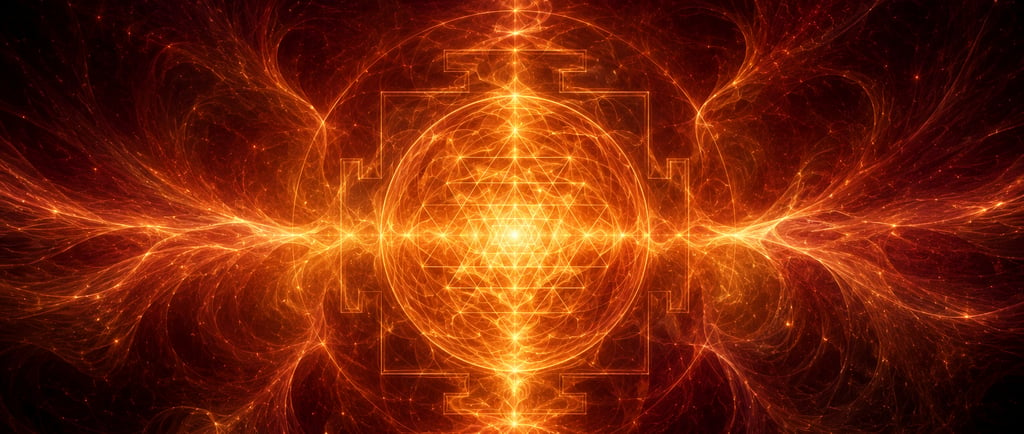
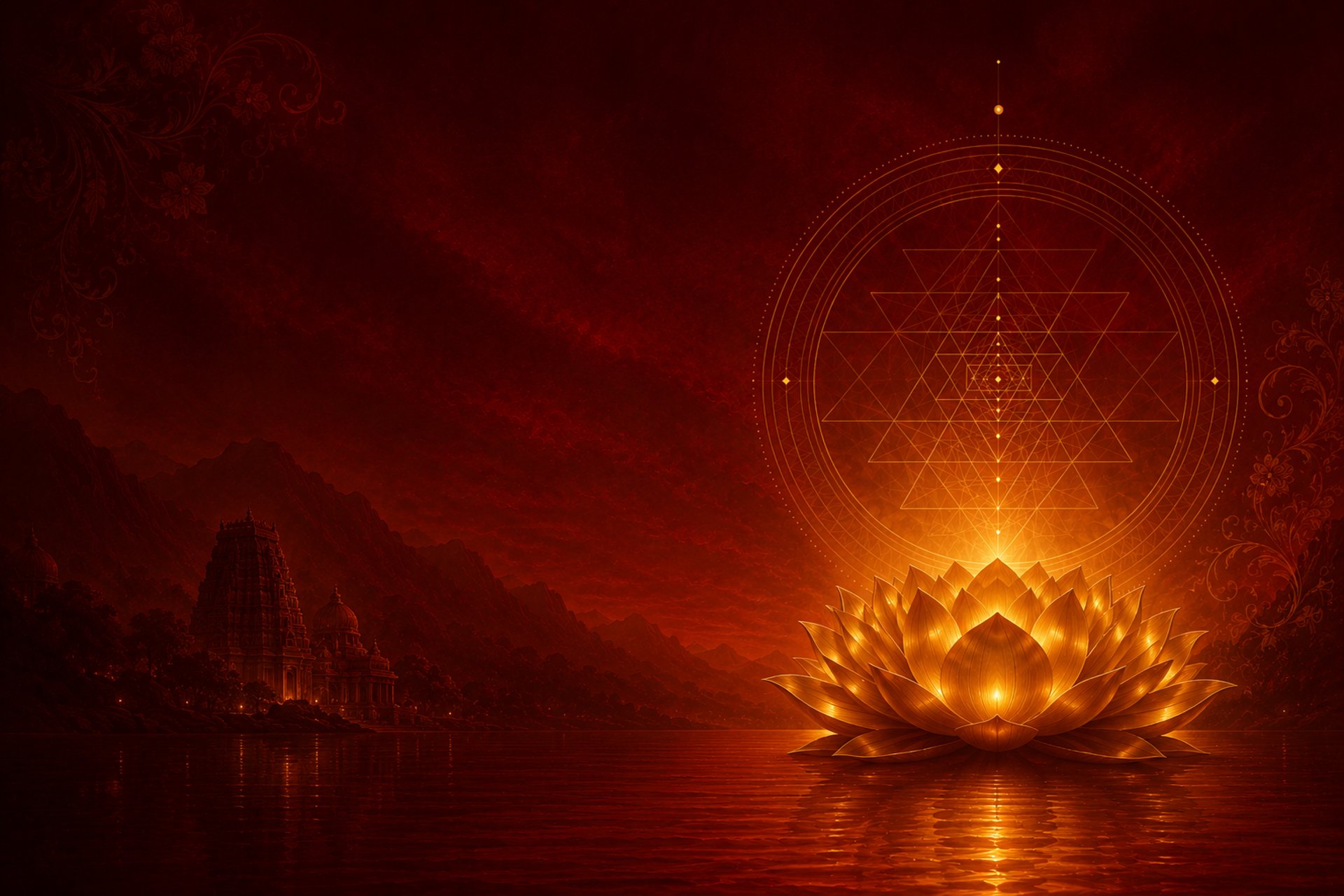
In the Śrīcakra, the Bindu is the central point.
All the triangles, lotuses, and enclosures radiate outward from it.
The Bindu is therefore:
the origin,
the center,
the culmination.
The Divine Mother is said to dwell there.
4. Traditional Meaning
The Divine Mother is called Bindu-maṇḍala-vāsinī because she resides in the supreme center of the Śrīcakra.
This center is regarded as the highest abode of Lalitā Tripurasundarī.
All worship of the Śrīcakra ultimately culminates in the Bindu.
5. Devotional Meaning
For a devotee, this name teaches that all spiritual practices eventually lead to the Mother's innermost presence.
The many paths, symbols, rituals, and forms are like concentric circles guiding the seeker toward the sacred center.
There the Mother awaits.
6. Śrīvidyā Meaning
In Śrīvidyā, the Bindu is not merely a geometric point.
It is the point of perfect unity where:
Śiva and Śakti are one,
knower and known are one,
subject and object are one.
The Mother dwelling there signifies the highest state of realization.
7. Advaita Vedāntic Meaning
Now the deeper layer.
Why does this name follow Oḍyāṇa-pīṭha-nilayā?
The previous name described spiritual ascent.
This name reveals the destination of that ascent.
The ascent culminates not in movement through space, but in arrival at the center.
A profound insight
A point has no dimensions.
Yet from the Bindu arises the entire universe of dimensions.
This paradox is intentional.
The infinite multiplicity of existence emerges from an indivisible unity.
The Mother is that unity.
The hidden teaching
Every journey involves movement from the periphery toward the center.
Human consciousness ordinarily lives at the periphery:
absorbed in objects,
thoughts,
identities,
experiences.
The spiritual path gradually leads inward.
The Bindu symbolizes the innermost center of being.
The Center Everywhere
Mystics often describe the Divine as:
a center that is everywhere and a circumference nowhere.
The Bindu points toward this mystery.
It appears as a point, yet it contains all possibilities.
Similarly, Consciousness appears intimate and immediate, yet it pervades everything.
The Union of Śiva and Śakti
In the highest Śrīvidyā understanding:
The Bindu is the perfect union of:
Pure Consciousness (Śiva),
Pure Power (Śakti).
Not two realities merging.
One reality recognized in its fullness.
The Mother dwells there because she is that fullness.
Beyond Space
Although described as a point, the Bindu is not spatial.
It represents the source from which space itself arises.
Thus the Mother as Bindu-maṇḍala-vāsinī transcends all notions of location.
Relation to Earlier Names
Observe the magnificent progression:
Parā — The Supreme.
Pratyak-citi-rūpā — Inner Consciousness.
Jālandhara-sthitā — Established in a sacred seat.
Oḍyāṇa-pīṭha-nilayā — Dwelling in the seat of ascent.
Now:
Bindu-maṇḍala-vāsinī
Abiding in the ultimate center from which all existence emerges.
The Non-Dual Meaning
At the highest level, the Bindu is the Self.
The center sought in sacred diagrams and spiritual practice is the innermost Consciousness.
The Mother is called Bindu-maṇḍala-vāsinī because she abides eternally as that central reality.
The seeker's journey ends where it began—in the Self.
A deeper contemplation
Human life often unfolds at the edges of experience.
Attention moves constantly toward objects, events, relationships, ambitions, and concerns.
The center is forgotten.
Yet every tradition speaks, in one way or another, of a return to the center.
The Divine Mother as Bindu-maṇḍala-vāsinī represents that center.
The Bindu is among the most powerful symbols in spiritual thought because it unites apparent opposites.
It is infinitely small, yet contains the entire universe.
It is motionless, yet gives rise to all movement.
It is simple, yet contains limitless complexity.
These paradoxes point toward Consciousness itself.
The seeker's journey can be understood as a movement from multiplicity back to unity.
The many experiences of life gradually reveal their common foundation.
The countless thoughts and perceptions are recognized as arising within a single awareness.
The many forms of the Divine are discovered to radiate from a single source.
That source is the Bindu.
The Mother dwelling in the Bindu is not merely the ruler of creation.
She is the innermost essence of existence.
She is the still center around which all worlds revolve and the silent reality from which all manifestation emerges.
To contemplate Bindu-maṇḍala-vāsinī is to recognize the Divine Mother as the supreme center of existence, the source and culmination of the universe, and the non-dual Consciousness in which all multiplicity arises and dissolves. She dwells eternally in the Bindu, the sacred point of perfect unity where the seeker discovers the ultimate truth of the Self.
One-line Essence
Bindu-maṇḍala-vāsinī reveals the Divine Mother as the supreme center of all existence, abiding in the primordial Bindu from which the universe emerges and into which all multiplicity ultimately returns.