245. Cakrarāja-niketanā
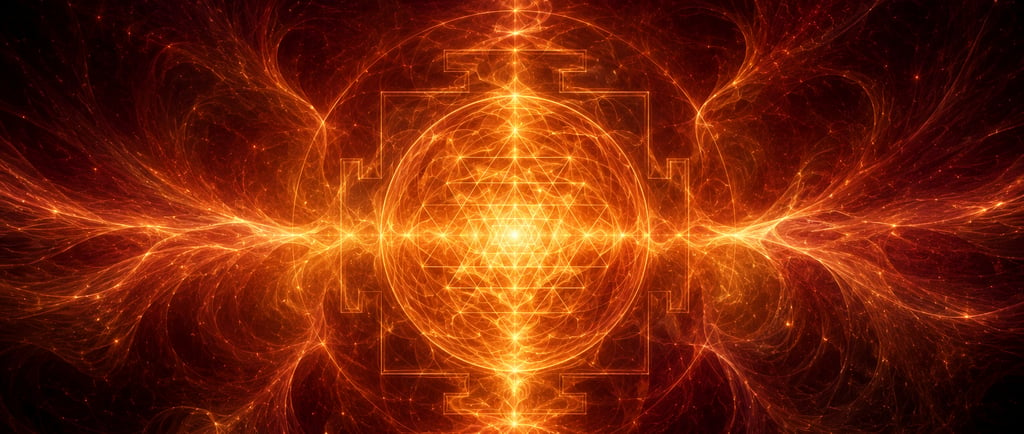
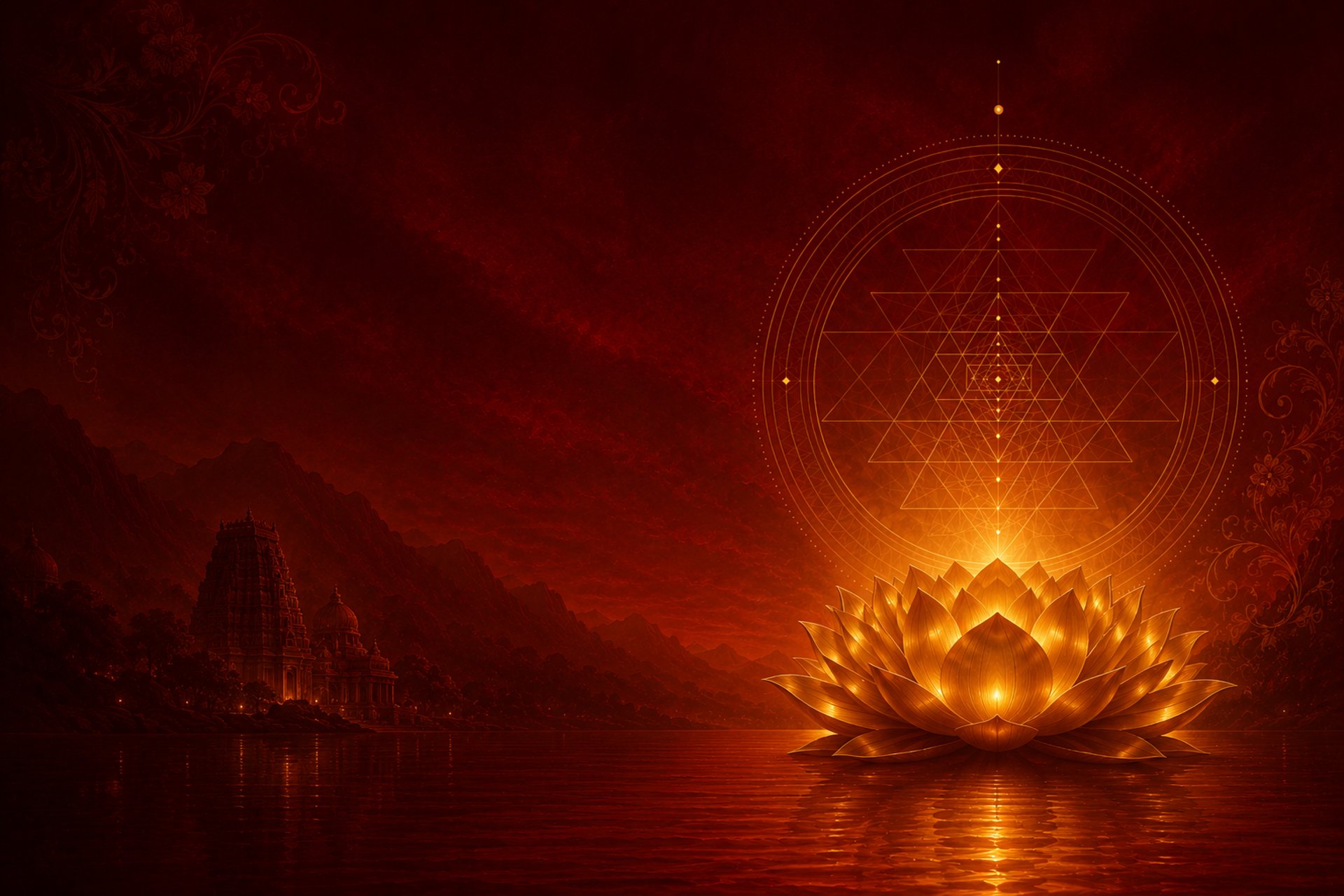
Cakrarāja-niketanā reveals the Divine Mother as residing in the Śrīcakra, the King of Yantras and the supreme symbol of cosmic and spiritual reality. The name teaches that the ultimate abode of the Divine is the innermost center of consciousness, where all distinctions dissolve and the seeker discovers the unity underlying the entire universe.

Cakrarāja-niketanā (चक्रराजनिकेतना)
This is the 245th name of the Lalitā Sahasranāma.
Having revealed the Divine Mother as Carācara-jagannāthā, the Sovereign of the entire universe, the Sahasranāma now reveals the sacred abode from which that sovereignty radiates:
Cakrarāja-niketanā - She who dwells in the King of Chakras; She whose abode is the supreme sacred diagram known as the Śrīcakra.
This is one of the most important names in Śrīvidyā, for it directly identifies the Divine Mother's residence with the supreme mystical diagram of the tradition.
1. Literal Meaning
Word-by-word
Cakra – wheel, circle, sacred diagram, mystical energy structure
Rāja – king, supreme, sovereign
Cakrarāja – the King of Chakras, the supreme sacred diagram
Niketanā – abode, dwelling place, residence
Literal translation
"She who dwells in the King of Chakras."
or
"She whose abode is the supreme Śrīcakra."
2. Traditional Meaning
The Cakrarāja is the:
Śrīcakra
Among all yantras, the Śrīcakra is regarded as the highest because it contains within itself:
the entire cosmos,
all divine powers,
all levels of consciousness,
the complete path to realization.
The Divine Mother resides in its central bindu, and therefore She is called Cakrarāja-niketanā.
3. Devotional Meaning
For a devotee, this name reveals the Śrīcakra as not merely a sacred symbol but a living temple of the Divine Mother.
Every enclosure (āvaraṇa) of the Śrīcakra represents aspects of Her power and grace.
At its center She shines as Lalitā Mahātripurasundarī.
Meditating upon the Śrīcakra becomes a way of approaching Her presence.
4. Śrīvidyā Meaning
In Śrīvidyā, the Śrīcakra is considered the geometric body of the Divine Mother.
Its structure symbolizes:
creation,
sustenance,
dissolution,
concealment,
revelation.
The journey from the outermost enclosure to the bindu mirrors the seeker's journey from multiplicity to unity.
As Cakrarāja-niketanā, the Mother abides at the culmination of that inward journey.
5. Advaita Vedāntic Meaning
Now the deeper layer.
What is the Cakrarāja?
At one level, it is a sacred geometric form.
At a deeper level, it is a map of consciousness.
The many enclosures symbolize the layers of experience through which the mind moves.
The bindu symbolizes the indivisible source from which all experience arises.
Why is the Mother said to dwell there?
Because the bindu represents the center of all manifestation.
Everything emerges from it.
Everything returns to it.
The Mother abides there because She is the source and culmination of existence.
A profound insight
The previous name:
Carācara-jagannāthā
Sovereign of the entire universe.
This name:
Cakrarāja-niketanā
Resident of the supreme center.
The sequence is beautiful.
The Mother governs the entire cosmos, yet Her abode is the innermost center from which the cosmos unfolds.
The infinite and the infinitesimal meet in the bindu.
The universe and the Śrīcakra
The Śrīcakra is often described as a miniature representation of the universe.
Yet from another perspective, the universe itself is a vast Śrīcakra.
Every level of manifestation radiates outward from a hidden center.
The Mother is that center.
The hidden teaching
The true Śrīcakra is not merely external.
Its deepest meaning lies within consciousness itself.
The bindu represents the spiritual heart—the indivisible point of Awareness from which thoughts, perceptions, and experiences arise.
The Mother dwells there.
Beyond location
To say that the Mother resides in the Śrīcakra is not to confine Her.
The Infinite cannot be contained by any form.
Rather, the Śrīcakra serves as a sacred doorway through which the mind may approach the realization of the Infinite.
Relation to Earlier Names
Notice the progression:
Mahāyantrā - She is the Great Yantra.
Mahāsanā - She is established on the supreme throne.
Carācara-jagannāthā - She is the Sovereign of the universe.
Cakrarāja-niketanā - She dwells in the supreme center of that universe.
The Sahasranāma continually moves between cosmic and inward dimensions, revealing them as one.
A deeper contemplation
Human beings often search for the Divine in distant places.
Yet spiritual traditions repeatedly point inward.
The Divine Mother as Cakrarāja-niketanā teaches that the center of the cosmos and the center of consciousness are not two different realities.
The bindu of the Śrīcakra symbolizes the point where all divisions disappear.
There:
subject and object,
seeker and sought,
worshipper and worshipped,
merge into unity.
The Mother resides there because She is that unity itself.
To contemplate Cakrarāja-niketanā is to recognize that behind the complexity of life lies a silent center of awareness. From that center the entire universe unfolds, and to that center every spiritual journey ultimately returns. There the Divine Mother eternally abides as the source, support, and fulfillment of all existence.
One-line Essence
Cakrarāja-niketanā reveals the Divine Mother as dwelling in the bindu of the Śrīcakra, the supreme center of consciousness from which the universe arises and in which all multiplicity resolves into unity.